
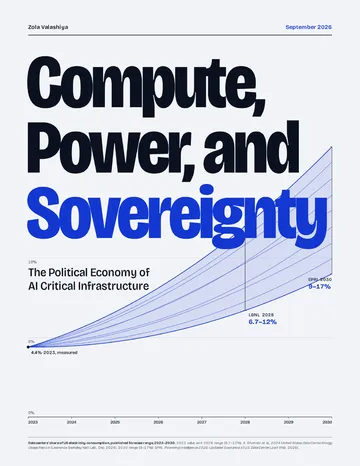
Abstract
This report examines how the United States allocates the costs, risks, and control of AI compute paired with dedicated electricity generation. It organizes the inquiry around three bargains: developers and utilities, developers and host governments, and private infrastructure providers and the federal security state. Across these bargains, it asks who pays, who controls, who decides, and who can inspect the terms.
The report argues that demand risk is a central mechanism connecting these questions: who bears the cost when expected electricity demand fails to arrive, falls short, or leaves before the supporting assets are paid off. Through regulatory proceedings, contracts, corporate disclosures, fiscal evaluations, and security instruments, it examines how minimum payments, exit charges, collateral, guarantees, and disclosure rules allocate that risk. It distinguishes electricity-price effects from cross-subsidies and public commitments from enforceable obligations.
The report proposes nine measures for existing institutions, including public contract terms, stronger financial protections, conditional tax incentives, and published criteria for federal security claims. Its focus is the United States, with Ireland and Singapore as comparators. It states the evidence that would weaken its conclusions and the limits of its public record, using a research cutoff of September 27, 2026.
About the work
Compute, power, and sovereignty is a research report at the intersection of AI governance, energy regulation, public finance, and national security. Its subject is the relationship between computing facilities and generation dedicated to serving them. The report calls this relationship a “coupling” and follows the institutions that approve, finance, regulate, and contest it.
It sets out to explain how individual infrastructure agreements distribute responsibilities that extend beyond the contracting parties. A utility agreement may allocate the risk of an unfinished project; a tax exemption may reward investment that would have happened anyway; a security claim may seek to change which institution decides. The report brings these questions together and proposes terms that public bodies could adopt, identifying where legislation would be needed.
The intended readers include policymakers, regulators, lawyers, AI governance professionals, and people evaluating the public consequences of data-center development. The HTML page is an introduction and reading guide; the downloadable report contains the full argument, figures, and source notes.
Main arguments
- Demand risk connects the bargains. The report follows the financial consequences of forecast demand that never materializes or disappears early. It examines who remains responsible after minimum-payment obligations, collateral, guarantees, or contract terms run out.
- Public approval does not necessarily make an agreement publicly assessable. The report distinguishes a regulator’s access to confidential documents from the public’s ability to inspect the terms. It argues for disclosure of structural obligations while allowing protection for some commercially sensitive pricing information.
- Infrastructure configuration matters. The report compares utility-owned generation, co-location, on-site supply, bridging generation, and islanded plants. It asks how changes in configuration affect regulatory coverage, control, and responsibility.
- Fiscal benefits depend on what the incentive actually changes. The report examines whether tax preferences attract investment that would otherwise go elsewhere. It separates initial location decisions from later equipment replacement and distinguishes state costs from local revenue gains.
- Security claims need defined public obligations. The report examines what the federal government offers infrastructure providers and what it can publicly demonstrate it receives in return. It proposes criteria for security claims without assuming that every AI facility qualifies as critical infrastructure.
- The proposed response uses existing institutions. Nine measures address disclosure, cost allocation, financial protection, service flexibility, reliability, tax incentives, siting, federal leases, and security claims. Each identifies an actor, an instrument, and a practical limitation.
Inside the report
The report opens by defining its central claim, scope, and competing explanations, then examines environmental and local objections involving water, air, electricity, noise, and land. It identifies the forms of compute paired with dedicated generation and maps the institutions that regulate their costs, reliability, security, and disclosure. Three sections examine the bargains between developers and utilities, developers and host governments, and private infrastructure providers and the federal security state. The discussion then follows the losses that individual agreements may leave with ratepayers and taxpayers, considering forecast error, financing structures, and the gap between contract terms and asset lifetimes. The final sections develop nine proposed measures, identify the institutions responsible for acting, and set out the evidence and pending decisions that could change the conclusions.
Scope and edition
This is the September 2026 edition. Its main US jurisdictions are Wisconsin, Virginia, Indiana, Louisiana, Ohio, and Texas; Ireland and Singapore serve as comparators. The report’s stated cutoff is September 27, 2026, rather than an assertion that all pending matters remain unchanged today.
The report does not claim to establish a retail cross-subsidy or to classify every compute-generation arrangement as critical infrastructure. It distinguishes proposed measures from existing obligations and sets out limitations on the evidence available to the public.
Informational research, not legal advice.
Zola Valashiya · AI Lex Intelligence